

It’s been a long road, but Stafford Festival Shakespeare 2023 took place earlier this year.
While the cabinet analyse what it feels is right, its the right time to properly sit back and analyse what worked, what didn’t, what was promised, and what was delivered.
Let’s first cast our minds back to the original reasons for the move ; Freedom Leisure’s decision was made when rising costs of their leisure centres meant it couldn’t maintain that in addition to a Shakespeare production at Stafford Castle that doesn’t make a profit – namely down to the logistical costs of the putting on an open air event.
What worked about the production?
It was clear that the Gatehouse Staff did put their all into the production. The production achieved mostly four star reviews, and the production quality itself was similar to that seen of the Castle in many ways. It recieved some good customer feedback, and all in all seems to have gone well.
While not trying to replicate the castle, the Gatehouse team did a large amount of work around the theatre to embody a unique atmosphere – shown mostly through tonnes of ivy, fresh flowers and specially created vinyls covering the building alongside a walkway of lit up trees.
The Gatehouse tried to recreate a picnic before the show with some specially created platters, and these seemed to sell well.
With some heavy showers over the run, the move kept audiences dry.
Some audience members who felt they were unable to attend Shakespeare at the Castle due to access requirements were able to do so at the Gatehouse.
For the first time, the Gatehouse produced a smaller show aimed at young children to compliment the production.
The show had a large company of performers that would rival some of the large producing houses across the country.
What didn’t work with the production?
The production didn’t sell as well. Going off seating plans, closely monitered throughout the run, the production achieved around 50% capacity on average. It undersold last years Romeo and Juliet by around 45% and around 20% in 2019.
Ticket prices didn’t reduce. Although an early bird price of £25 was available, tickets then went to £35 for every seat for every show. The high entry point made the production more expensive than entry prices at the RSC, The Globe, and most West End shows. It also meant those seeing the show in previews saw a show being worked on for the same price as those who saw a polished performance.
National Coverage – although thanks to some of the casting attracting national press there were some name drops in the national press, including on TV, it was the first time in many years The Stage didn’t review the production.
Although the production managed to maintain some of its local regular base, others didn’t. Time will tell if the reduced number of visitors was more or less diverse than previous years.
For those who didn’t wish to purchase a platter at the Gatehouse, there was no ability to recreate the feeling of having a night out with a picnic and making an evening of it.
Due to lower attendance than usual, the overall impact on the local economy will be reduced.
Likely due to low ticket sales, there was a last-minute huge discount code offer – which could negatively impact advance ticket prices going forward. It would have also led to a lower box office returns than forecast.
How does this weigh up against the risks advised to the council when making the decision to move the production?
Here are the pros and cons outlayed to the council for moving the production to the Gatehouse:
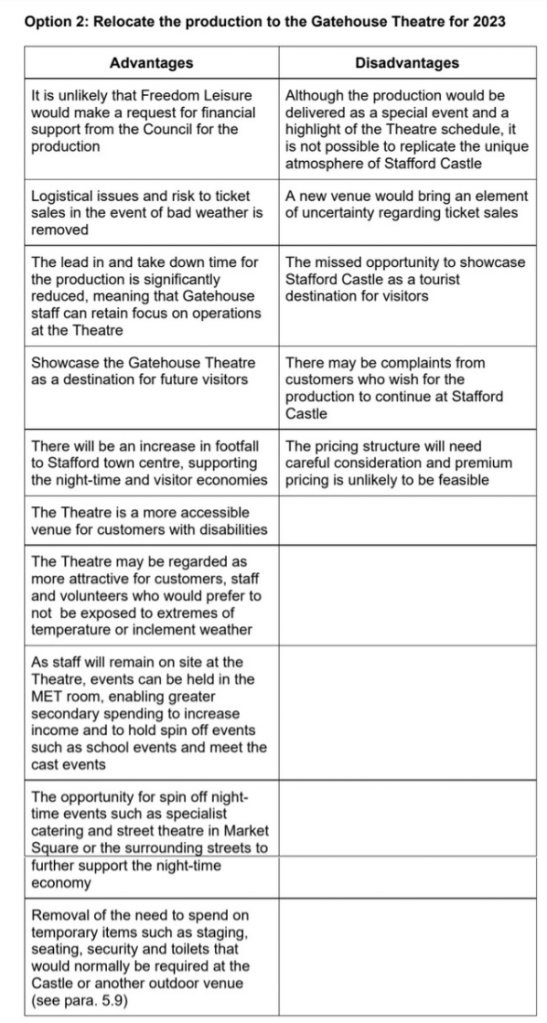
Looking at the advantages I would argue a number of these didn’t come to fruition, while others did.
Although low in impact, due to low attendance, for those who did see the production likely did have an increased perception of the Gatehouse. Particularly by those who didn’t realise Shakespeare at the Castle was produced by Stafford Gatehouse.
The was a number of people were able to see the production that normally wouldn’t be able to. However, other areas of acess may have been comprised, families, new audiences, younger audiences, audiences that wouldnt usually attend the gatehouse, audiences with low amounts of disposable income.
Some did see the advantage of there not being the uncertainty of the weather.
The theatre would have saved on temporary seating and other infrastructure needed at the Castle. It’s not public information if the production made a loss or profit, but the industry will not be aiming for a 40% occupancy production to turn a profit.
Underpinning a lot of this is a large decrease in audience which comes with a less greater impact on local community impact and overal value for money for tax payers.
What could have contributed to low ticket sales?
Change is always tricky to navigate. Some people undoubtedly voted with their feet. Others were likely deterred by the steep ticket prices. Others may have decided that it was no longer a unique event. Others may have been swayed by other local outdoor productions. No matter what the future holds, all these audiences must be reached.
The disadvantages of the move largely did come to fruition – uncertain ticket sales lead to low ticket sales, pricing structures were created that arguably deterred those unsure of the production and made the production less accessible. There were still complaints about the move during the production and the financial viability of the production is yet unknown.
Was I convinced that Shakespeare at the Gatehouse will win back and grow its audience?
As someone who speaks so critically about the importance of access into theatre, this can’t be summed up with a simple answer. There are positives to take from the move, there are negatives.
A Midsummer Night’s Dream is the most produced title from Shakespeare and if that wasn’t enough to win audiences in full around, I’m not sure what will. The title lended itself well to the transformation of the Gatehouse, as soon as you produce something like Hamlet, Macbeth, one of the Histories, that transformation makes it much more challenging. Ultimately, Stafford Shakespeare is an annual event, it shouldn’t strive to be the RSC, it shouldn’t strive to be the Barbican, it should strive to produce a stunning, show that people can’t ignore and an annual event no local person can pass up.
It’s for that reason, I remain unconvinced that a production that attracts less can be seen as a stronger production.
I do, however, feel like lessons can’t be learnt from this experience to ensure the future of this annual event.
I’d like the Gatehouse to work with those audiences who came to the Gatehouse because it was at the Gatehouse and understand what accessibility requirements are needed for them to view it at the Castle or to offer support to them. Perhaps a one off live stream shown indoors at the Gatehouse either during or after the production could be a possible solution to aid with this?
Lessons equally could be learned from casting. Lots was promised originally, including A list celebrities. I’m not a fan of stunt casting, but equally respect it can be done well and encourge a different audience mix to usually and higher ticket sales. The casting quality was great, but if names were chosen to increase ticket sales, a full review of that impact should be done. Can money be saved here or spend more carefully with attracting one stunning casting choice, that aids with ticket sales and bringing a new audience.
The infrastructure of Stafford Shakespeare should be reviewed. Is there a better/ more efficient way of doing this outdoors? E.g could the stage be used for a longer period for other productions or events to make it more cost effective? Movie nights under the stars, drone shows above the castle, other live shows and many more. A big issue with Stafford Shakespeare’s financial statbility is its short run covering infrastructure costs. Let’s work with this to allow the production to be financially sound as I do strongly dispute that this production can not be financially viable.
The pricing structure needs to be revised, no matter the venue. Perhaps instead of one price for all, different price bands need to be created to allow cheaper entry points.
More should be looked at with regards to attracting private funding – whether that be through sponsorship, working out the barriers to achieve arts funding, unlocking grants, and philanthropy. All of these and more are critical for an arts organisations to thrive in 2023. The Gatehouse doesn’t have a friends or membership scheme, that could be looked at to generate much needed income to support the overall funding structure of the Gatehouse?
To conclude, I’ll use what we now know to match this up against the following buisness objectives that the council sets for the Gatehouse for Stafford Shakespeare

Ultimately, with fewer audiences seeing the production and a now split audience, I believe it does meet these objectives are not as well met as they were.
I don’t doubt the skills of people who work at the Gatehouse to drive this project forward whatever the venue. However, I am questioning what further skills and talents Freedom Leisure brings to the Gatehouse in exchange for the management fee they take. They have a vast experience level with managing Leisure centres, but much less so at managing and supporting a local theatre. Could there be a stronger, more resilient model for the Gatehouse that is outside of Freedom Leisure’s control that unlocks its potential to be a well rounded venue that has foundations in both sustainability and artistic merit?
 The Theatre Twittic
Leave a comment